 214-556-0555
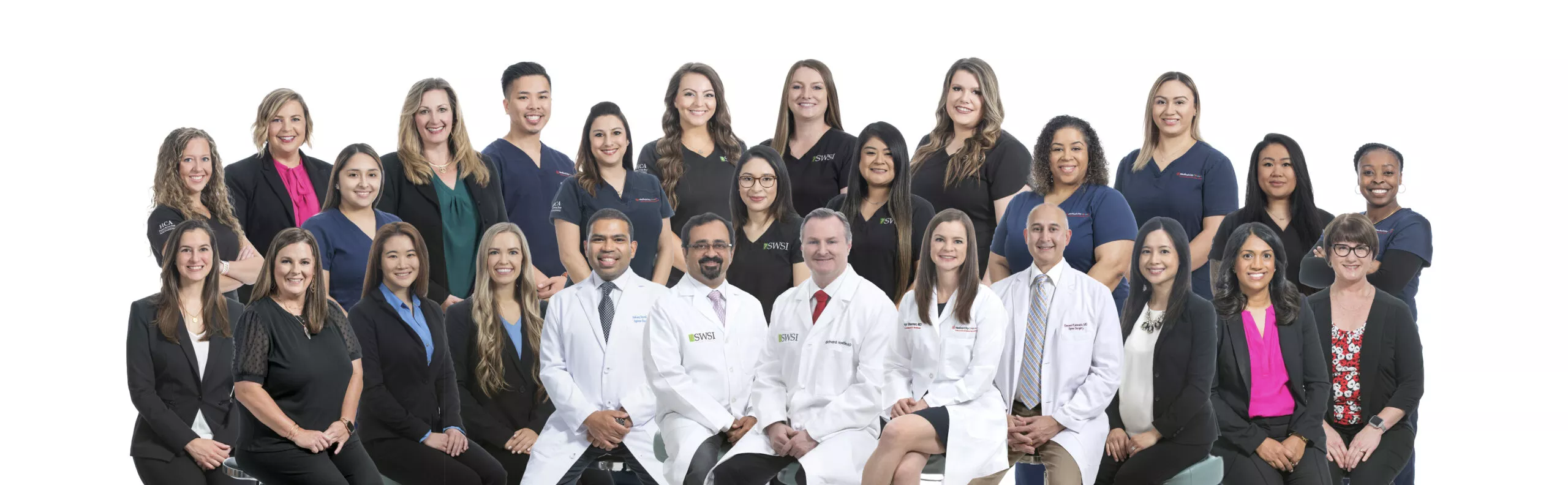
Richard A. Hostin, MD
At Southwest Scoliosis and Spine Institute, Dr. Richard Hostin is renowned for his expertise in treating complex spinal deformities. Board-certified and fellowship-trained, Dr. Hostin combines exceptional skill with a compassionate approach, ensuring each patient receives highly personalized, world-class care. Together with our dedicated team of nurses, care coordinators, and technicians, Dr. Hostin offers the most advanced spine treatments to help patients both, pediatric and adult, achieve their best outcomes.



Richard A. Hostin, MD
Dr. Richard A. Hostin is a board-certified spine surgeon fellowship-trained in orthopedic surgery. He treats a comprehensive range of spinal diseases and disorders that include scoliosis, complex spinal deformity; advanced spine surgery, degenerative conditions of the spine; and spinal trauma, tumors, and infections. Dr. Hostin is trained in modern spinal surgical techniques, including minimally invasive surgical methods. His practice focuses on primary and revision pediatric, adolescent, and adult spinal deformities.
He grew up in Southern California and earned his bachelor’s degree from UC Berkeley. He went on to complete medical school at the University of Oklahoma, earning membership in the medical honor society Alpha Omega Alpha. Dr. Hostin completed his orthopedic surgery residency at UC Davis in Sacramento, California, and then went on to receive additional specialized training in spinal surgery during his fellowship at the Twin Cities Spine Center in Minneapolis.
Dr. Hostin is the medical director of the Medical City Scoliosis & Advanced Spine Center. Previously, he served as medical director of the Baylor Scott and White Scoliosis Center – Plano and Chief of Orthopedics at Baylor Scott and White Medical Center – Plano. He is an active member of the American Academy of Orthopaedic Surgeons, North American Spine Society, Scoliosis Research Society, and International Spine Society Group. Dr. Hostin has contributed to numerous nationally renowned research projects and hundreds of other publications and projects, including book chapters regarding complex spine surgery.
Dr. Hostin specializes in the treatment of all types of Scoliosis, Complex Spine Disorders, and Revision Surgeries for children through adulthood.
- Scoliosis – all types and all ages of patients
- Spine Deformities
- Complex Spine Disorders
- Revision Surgery for failed back surgeries
- Cervical Myelopathy
- Complex Spine Conditions
- Disc Herniation
- Kyphosis
- Sciatica
- Spondylolisthesis
- Spine Deformity
- Stenosis of the spine
Outside of work, Dr. Hostin enjoys spending time with his wife, Savannah, and two children. He also enjoys traveling, recreational auto racing, and skiing.
Dr. Hostin has offices in Dallas and Plano.
He accepts new patients and most insurance plans.
Contact us today for an appointment!
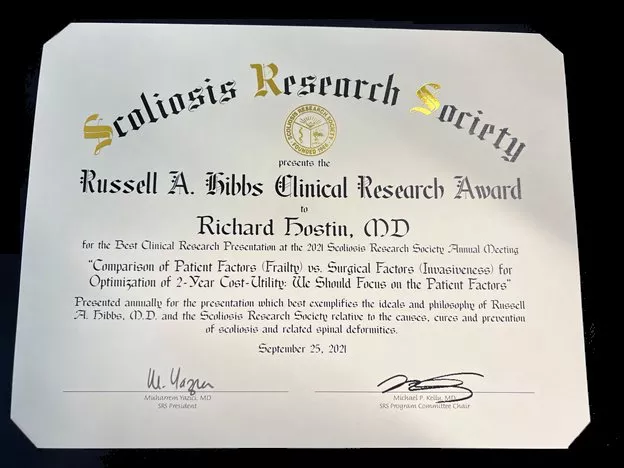
AWARDS
Best Doctors Spinal Surgery (Scoliosis) 2024 2023, 2022, 2021, 2020, 2019, 2017, 2013, and 2011 – D Magazine
Best Doctors in Collin County – 2017, 2015, 2014, 2013, 2012, 2011
Super Doctors – Top Doctors 2022, 2021, 2020, 2019, 2018, 2017, 2016, and 2015.
Super Doctors – Rising Star 2014 and 2013.
Addison Top Doctors Award – 2014




















Curriculum Vitae
Richard A Hostin MD
Pediatric and Adult Spine Surgeon
- Physician and Owner, Southwest Scoliosis and Spine Institute
- Medical Director of Pediatric Spine and Scoliosis, Medical City Children’s Hospital
- Medical Director of the Medical City Scoliosis & Advanced Spine Center
Education
August 1996 – May 2000 Oklahoma City, Oklahoma
- University of Oklahoma Health Science Center
- Doctor of Medicine
- Alpha Omega Alpha
- Excellence in Research Award
- Honors Research Scholar
August 1990 – December 1994 Berkley, California
- University of California at Berkley
- Bachelor’s Degree – Psychology
Post-Graduate Training
August 2005 – July 2006 Minneapolis, Minnesota
- Twin Cities Spine Center
- Fellowship – Pediatric & Adult Spine Surgery
July 2004 – June 2005 Berkley, California
- University of California Davis at Berkley
- Chief Residency
July 2001 – June 2004 Berkley, California
- University of California Davis at Berkley
- Residency
June 2000 – June 2001 Berkley, California
- University of California Davis at Berkley
- Internship
- Texas Medical Board State License
- California Medical Board State License
- American Board of Orthopedic Surgeons
- Oklahoma State Board of Medical Licensure and Supervision
- Louisiana State Board of Medical Examiners
Society Memberships
Licensures / Board Certifications
- American Academy of Orthopedics Surgeons
- Alpha Omega Alpha
- North American Spine Society
- Texas Spine Society
- HARMS / ISSG Active Fellow
- Scoliosis Research Society
- Texas Orthopaedic Association
- International Spine Study Group (ISSG)
- American Medical Association
- Collin-Fannin County Medical Society
Research & Publications
Richard A. Hostin, Jr., MD – Southwest Scoliosis and Spine Institute
Each of the 181 Research Projects below is explained in plain English so patients and families can understand the real-world impact.
→ Access PubMed and all of Dr. Hostin’s completed research publications or a synopsis listed below
Open Access Content
December 2025
Quantifying the Importance of Upper Cervical Extension Reserve in Adult Cervical Deformity Surgery
This study examines how much extension movement remains in the upper cervical spine before surgery and why that reserve matters. The research shows that limited upper cervical extension affects baseline presentation and influences surgical outcomes. Understanding this reserve helps surgeons plan cervical deformity correction more accurately and anticipate postoperative alignment and function.
December 2025
Age and Baseline Disability Inform Tradeoffs in Cost Utility of Adult Spinal Deformity Surgery
Description: This project evaluates how patient age and preoperative disability influence the cost-effectiveness of adult spinal deformity surgery. The findings show that younger patients and those with greater baseline disability often achieve greater quality-of-life gains relative to cost. The study helps clinicians and health systems balance clinical benefit with healthcare resource utilization.
November 2025
Impact of Lower Extremity Arthritis and Cervical Deformity on Outcomes in Thoracolumbar Spinal Deformity
Description: This study examines how coexisting lower extremity arthritis and cervical deformity influence patient-reported outcomes following thoracolumbar deformity surgery. The results show that these conditions negatively affect pain, function, and overall recovery. The findings help surgeons better counsel patients and set realistic expectations.
November 2025
Impact of Complications on DRG Assignment for Adult Spinal Deformity Surgery Using the ISSG-AO Classification System.
Description: When something goes wrong during major spine surgery (infection, bleeding, etc.), hospitals get paid using fixed Medicare codes (DRGs). This study showed that the current Medicare payment system doesn’t fairly capture how much harder and more expensive it is to care for patients who have complications — meaning hospitals often lose money treating the sickest scoliosis and deformity patients.
Description: When surgeons fix a severely curved or flat lower back, they can choose to put most of the curve correction in the upper or lower part of the lumbar spine. This paper showed that where you make the correction changes the final shape of the spine and affects pain, balance, and long-term results.
Description: Can experienced surgeons predict proximal junctional failure? Even the best deformity surgeons cannot reliably look at a patient’s X-rays and surgical plan and predict who will develop a “junction” problem (the spine breaking or bending just above a long fusion). This means we still need better tools and rules to prevent this common complication.
Description: If the top vertebra of a long fusion is tilted or slipped forward, patients have a much higher chance of developing proximal junctional kyphosis (a sharp bend or collapse just above the fused section). Fixing the tilt at surgery lowers that risk.
Description: New computer-adaptive questionnaires (PROMIS) are more accurate than old paper surveys at showing how much better patients feel two years after major scoliosis/deformity surgery — and proved that most patients return to normal levels of pain, function, and mental health.
Description: Many patients with a stiff, hunched neck (cervicothoracic kyphosis) also have sideways scoliosis in the neck. This study showed that the sideways curve does affect final outcomes, so surgeons should pay attention to both the forward hunch and the side curve.
Description: Medicare’s fixed payment buckets for complex spine surgery are too simple — they don’t account for how invasive the operation is, how long patients stay in hospital, or where they go after discharge. The system needs to be updated so hospitals aren’t punished for taking the hardest cases.
Description: A small group of deformity patients use a huge amount of medical resources (multiple surgeries, long hospital stays, readmissions). The biggest warning signs are: very invasive first surgeries, needing revision surgery, and having depression before the operation.
September 2025
Beyond Kyphosis: Modes of Failure at The Proximal Junction in Adult Spinal Deformity.
Description: The “junction” above a long fusion can fail in many ways — not just bending (kyphosis), but also fractures, screw pull-outs, and ligament tears. Each type needs its own prevention strategy.
Description: Some patients with severe neck deformities have trouble breathing after surgery and can’t have the breathing tube removed quickly. Risk factors include older age, obesity, and very stiff curves — knowing this helps plan safer anesthesia and ICU care.
Description: How bad a patient feels about their appearance is one of the strongest drivers of whether they choose surgery and how happy they are afterward — even more than pain or disability in some cases.
Description: Over the last decade, surgeons have steadily improved at restoring the ideal amount and shape of lower-back curve in complex cases, and patients with the “perfect” alignment report the best long-term results.
Description: 3-column osteotomies with vs. without cages When surgeons do big bone cuts (osteotomies) to straighten a rigid spine, adding an interbody cage (spacer between vertebrae) gives slightly better curve correction and fewer complications than doing the osteotomy alone.
June 2025
Age and Baseline Disability Inform Tradeoffs in Cost Utility of Adult Spinal Deformity Surgery.
Description: Surgery for severe spinal deformity is extremely cost-effective in younger, very disabled patients, but the value drops in patients over 75 or those who are only mildly disabled — helping doctors and patients make smarter decisions.
Description: If the metal rods accidentally push the top vertebra backward during surgery, patients are much more likely to develop proximal junctional kyphosis later — a technical detail surgeons now watch carefully.
Description: For the most extreme deformities, doing the surgery in two separate operations (staged) instead of one long one-day surgery lowers complication rates in certain high-risk patients (very frail, huge curves, poor bone quality).
Description: A newer scoring system (GAP score) predicts outcomes better than older ones. This study identified which specific measurements in that score have the biggest influence on pain and function after surgery.
January 2025
The gap between surgeon goal and achieved sagittal alignment in adult cervical spine deformity surgery.
Description: Even experienced surgeons often fall short of their planned neck curve correction — on average missing the target by 10–15 degrees — showing we still have room to improve surgical techniques for the neck.
Description: This short letter commented on another group’s research showing that every complication adds extra hospital days — and agreed that Medicare payments need to reflect that reality.
December 2024
Redefining Clinically Significant Blood Loss in Complex Adult Spine Deformity Surgery.
Description: “Normal” blood loss numbers from textbooks don’t apply to big deformity cases. This paper proposed new, higher thresholds for when blood loss actually affects outcomes and requires extra treatment.
Description: Some patients who had shorter lumbar fusions years ago now have a flat lower back and pain because the original surgery didn’t create enough curve. This study defined how to recognize and fix this new man-made problem.
December 2024
Cause and effect of revisions in adult spinal deformity surgery: a multicenter study on outcomes based on etiology.
Description: Why patients need revision surgery varies — some because of infection, some because of alignment failure, some because of implant breakage. Outcomes after revision depend heavily on the original reason for failure.
Description: Patients whose first fusion stopped in the lower chest more often develop junction problems later than those stopped higher up — important information when planning the original surgery.
Description: Yes — over the last 10–15 years, even the oldest and sickest deformity patients are surviving surgery better, staying in hospital less time, and functioning better, thanks to better planning and techniques.
November 2024
Impact of Knee Osteoarthritis and Arthroplasty on Full-body Sagittal Alignment in Adult Spinal Deformity Patients.
Description: Bad knees force patients to stand differently, which affects the spine. Replacing arthritic knees can change spinal balance and sometimes improve symptoms in deformity patients.
October 2024
Unsupervised Clustering of Adult Spinal Deformity Patterns Predicts Surgical and Patient-Reported Outcomes.
Description: Using artificial intelligence to group deformity patients by X-ray patterns (instead of surgeon opinion) does a better job predicting who will do well or poorly after surgery.
September 2024
Incremental Increase in Hospital Length of Stay Due to Complications of Surgery for Adult Spinal Deformity.
Description: Every complication adds predictable extra days in hospital — for example, a wound infection adds ~5 days, pneumonia adds ~8 days, etc. This helps hospitals plan staffing and costs.
September 2024
Benchmark Values for Construct Survival and Complications by Type of ASD Surgery
Description: Gave surgeons national “report cards” for how long rods/screws last depending on type of surgery — so patients can be told realistic expectations about needing more surgery later.
August 2024
Impact of Prior Cervical Fusion on Patients Undergoing Thoracolumbar Deformity Correction.
Description: Patients who already have a fused neck face higher risks and slightly worse results when they later need major lower-back deformity correction.
Description: Bad hips and knees force the spine into odd positions; fixing the joints can sometimes improve spinal balance and symptoms.
Description: Walking tests predict pain & function better than X-rays Simple timed walking and balance tests before surgery tell us more about how patients will feel afterward than standing X-rays alone.
Description: Blood-clot prevention drug (TXA) is safe even in risky patients Using tranexamic acid (TXA) to reduce bleeding was safe and did not raise blood-clot risk, even in patients who were thought to be high risk.
Description: Different techniques for restoring the curve in the lowest part of the lumbar spine give different final shapes and different complication rates.
Description: Created a frailty index that stays stable after surgery so doctors can fairly compare how frail patients really were before the operation.
Description: Adding extra steps and more complicated steps during deformity surgery does give better curve correction and happiness, but only up to a point — beyond that, risk outweighs reward.
Description: Balance problems predict worse outcomes Patients who already complain of falling or unsteady walking before surgery have slower recovery and lower satisfaction afterward.
Description: Hip arthritis is common in severe deformity patients Over half of patients needing major deformity surgery also have bad hips; treating both problems together gives the best results.
Description: AI finds four types of deformity patients Machine learning sorted deformity patients into four groups that predict complications and outcomes far better than age or curve size alone.
February 2024
Validation of the Oswestry Disability Index in Adult Spinal Deformity.
Description: Oswestry questionnaire works well in deformity The classic Oswestry back-pain questionnaire is still accurate and useful in patients with complex scoliosis and deformity
Description: Most serious complications happen in the first 30 days; infections and lung problems peak early, while rod breaks happen later.
January 2024
Lumbar Lordosis Redistribution and Segmental Correction in Adult Spinal Deformity: Does it Matter?
Description: Simply making the overall lower-back curve bigger isn’t enough — how that curve is shared among the different levels makes a big difference in results.
Description: Spinopelvic alignment and top vertebra level predict painful junction kyphosis How tilted the pelvis is and how high or low the fusion stops are the two biggest warning signs that a patient will later feel pain and collapse just above the rods.
November 2023
Alterations in Magnitude and Shape of Thoracic Kyphosis Following Surgical Correction for Adult Spinal Deformity.
Description: Shape of the chest curve changes after big deformity surgery When surgeons straighten a badly hunched lower back, the mid-back (thoracic) curve often becomes flatter or even reverses direction; this is normal and usually helpful.
Description: Neck deformity patients are frailer than lower-back deformity patients People needing surgery for a stiff, crooked neck are generally older, weaker, and have more medical problems than those needing lower-back fixes.
Description: Longer operating time strongly predicts more bleeding, more complications, and longer hospital stays; keeping cases efficient improves everything.
Description: A detailed score that counts every intervention needed for complications (not just “major vs minor”) tells hospitals much more accurately how long a patient will stay.
Description: Sending patients to a nursing or rehab facility instead of straight home does not lower the chance of coming back to the hospital or needing more surgery.
September 2023
Economic burden of nonoperative treatment of adult spinal deformity.
Description: Bracing, injections, physical therapy, and pain meds for patients who never get surgery still cost society tens of thousands of dollars per year.
Description: What happens if patients can’t bend their hips and knees to stand up straight. Some deformity patients lose the ability to tilt their pelvis or bend their legs to compensate; those patients feel much worse and are harder to treat.
Description: For identical huge deformities, doing front surgery one day and back surgery the next gives almost the same curve correction with slightly fewer complications.
Description: Bad neck alignment before lower-back surgery makes junction problems more likely If the neck is already leaning too far forward before fixing the lower back, the risk of the spine kinking at the top of the fusion doubles
July 2023
Height Gain Following Correction of Adult Spinal Deformity.
Description: Patients actually grow taller after deformity correction. Fixing severe hunched spines gives an average height gain of 6–8 cm (2–3 inches) — a nice bonus patients love.
Description: A small group of patients get worse pain, more complications, and need more surgery; warning signs include very frail health and unrealistic expectations.
Description: Combining modern alignment targets, stronger rods, and better bone quality data creates a much more accurate calculator for who will develop junction problems.
June 2023
Use of multiple rods and proximal junctional kyphosis in adult spinal deformity surgery.
Description: Adding extra rods across the top of long fusions is one of the simplest and most effective ways to prevent the spine from collapsing above the construct.
Description: Doctors tend to rate results better than patients do; asking patients “Would you do it again?” is the best measure of true success.
Description: For severe curves, going all the way to the pelvis gives better long-term correction and happiness than stopping at L4 or L5.
Description: Medicare payments vary wildly between hospitals for the same surgery The exact same complex deformity case can be paid $40,000 at one center and $120,000 at another — mostly because of how complications are coded.
Description: SAAS acts like a “sweet spot” guide that reduces risks while maximizing benefits, outperforming previous one-size-fits-all approaches.
Description: Computer analysis of X-rays spotted deformity patterns that human eyes miss and predicted perioperative problems better than traditional scoring.
Description: Patients with severe neck deformity who undergo big corrective surgery keep most of their improvement in pain and function at 3 years.
Description: Across hundreds of patients followed for 4 years, major spine straightening surgery still shows big improvements in pain, disability, and quality of life.
September 2022
The Benefit of Addressing Malalignment in Revision Surgery for Proximal Junctional Kyphosis Following ASD Surgery.
Description: When patients come back with a collapsed junction, doing a second surgery to restore proper spinal balance gives excellent long-term relief.
Description: Surgeons are doing more aggressive bone removals than 10 years ago, and patients are getting bigger corrections with acceptable risk.
Description: Thanks to better planning, stronger rods, and blood-saving techniques, serious complication rates for complex deformity surgery fell steadily from 2012–2022.
Description: Both sudden collapses and gradual bending above fusions happen less often now than 10 years ago because of better techniques and implants.
Description: Patients on narcotics before surgery have more pain afterward, lower satisfaction, and the surgery is less cost-effective.
Description: The newer Roussouly shape-based system predicts real-life outcomes slightly better than the older Schwab system most surgeons still use.
Description: Most patients who need revision for junction problems had either too much or too little lower-back curve after their first surgery.
January 2022
Increasing Cost Efficiency in Adult Spinal Deformity Surgery: Identifying Predictors of Lower Total Costs.
Description: Shorter operating time, fewer osteotomies, and avoiding the pelvis when possible were the biggest drivers of lower total hospital bills.
Description: Very frail patients cost 2–3 times more because of longer ICU stays, rehab, and readmissions.
Description: A newer scoring system that customizes the “ideal” spine shape to each patient’s age predicts complications and happiness better than one-size-fits-all rules.
Description: Major bleeding, infections, and return trips to the OR were the costliest problems; obesity and smoking made them more likely.
Description: Poor leg strength, depression, and bad pelvic tilt on X-ray were the strongest predictors of low quality of life in patients who never get surgery.
Description: Patients with untreated depression have much more disability and slower recovery even after technically perfect surgery
Description: Matching curve size, pelvic tilt, and mechanical loading creates a balanced “ideal” shape that lowers the chance of collapse above the fusion.
Description: In 133 patients followed at least one year, major corrective surgery for severe neck deformity was safe in experienced hands, with acceptable risk and big improvements.
Description: Doctors can now give patients accurate predictions: “Most people your age with this curve will improve X points in pain, Y points in function, and Z in self-image.”
Description: Patients follow four different recovery paths after surgery: fast and great, slow but great, minimal improvement, or worsening. Knowing the path early helps manage expectations.
Description: Very frail patients take longer to recover and need more rehab, but by 3 years most reach the same level of pain and function as healthier patients.
Description: Using stronger rods and connectors AND avoiding over-straightening the spine together cut the risk of collapse above the fusion by more than half.
Description: A simple calculator using age, frailty, and curve size can spot the 5–10 % of patients who will cost 5–10 times more, so hospitals and insurers can plan.
Description: About 1 in 6 patients who already had one junction collapse will get it again after revision surgery; older age and osteoporosis are the biggest risks.
Description: A 5-item checklist (age, bone density, curve size, pelvic tilt, previous surgery) predicts who is most likely to develop junction problems.
September 2019
Cervical, Thoracic, and Spinopelvic Compensation After Proximal Junctional Kyphosis (PJK): Does Location of PJK Matter?
Description: If collapse happens high in the chest, the neck tilts back; if low, the pelvis tilts — location matters when planning revision.
Description: Long-term predictors of junction failure Over 5–10 years, over-correction of the lower back and weak bones were the strongest drivers of late junction failure.
May 2019
Comparison of Best Versus Worst Clinical Outcomes for Adult Cervical Deformity Surgery.
Description: Best vs worst results in neck deformity surgery Patients with the best outcomes had smaller curves to start, better bone quality, and surgery from experienced teams; the worst had the opposite.
Description: Surgery dramatically reduces back and leg pain In 324 patients followed 2 years, major deformity correction cut average back pain scores in half and leg pain by two-thirds.
Description: New formula for ideal neck curve T1 slope minus cervical lordosis (TS-CL) should be less than 17° — this simple number tells surgeons how much neck curve to aim for.
January 2019
Determinants of Patient Satisfaction 2 Years After Spinal Deformity Surgery: A Latent Class Analysis.
Description: Good alignment + low complications + meeting personal goals beat any single X-ray measurement for long-term satisfaction.
January 2019
Location of correction within the lumbar spine impacts acute adjacent-segment kyphosis.
Description: Fixing the curve only in the lower back puts more stress on the junction than spreading the correction higher up.
December 2018
Prospective Multicenter Assessment of All-Cause Mortality Following Surgery for Adult Cervical Deformity.
Description: Overall 1-year death rate was low (under 3 %), but smokers, very old patients, and those needing the biggest corrections had higher risk.
Description: Even patients over 70 did well with aggressive 3-column osteotomies if they were carefully selected; correction lasted 2 years.
Description: Patients kept most of their neck straightening and pain relief at 1 year, proving the improvement is durable.
Description: A simple online tool now tells patients their personal chance of reaching a “worth-it” level of improvement using the Oswestry score.
Description: The smallest improvement patients notice varies by age and starting disability — older or very disabled patients notice smaller changes than young healthy ones.
Description: New neck measurement (TS-CL) works like PI-LL in the lower back T1 slope minus cervical lordosis is the neck’s version of the famous pelvic incidence minus lumbar lordosis rule.
Description: People who already have metal in their back have the same chance of big improvement, but they don’t reach quite the same final level as first-time patients.
April 2018
Inter- and Intra-rater Reliability of the Hart-ISSG Proximal Junctional Failure Severity Scale.
Description: Created a reliable grading system (Hart-ISSG scale) so all surgeons describe junction problems the same way in research and clinic.
Description: In simple terms, the research shows surgeons should aim precisely for age-specific alignment to get the best results—under-straightening hurts outcomes, but going too far doesn’t help and can cause new problems. This has shaped modern planning, emphasizing balanced correction over perfection.
Description: Across 479 patients followed 2 years, surgery added an average of 3–5 extra quality-adjusted life years.
Description: The same deformity surgery can cost $80k in one center and $180k in another — mostly because of different complication rates and length of stay.
Description: The xipho-pubic angle (XPA) is an easy new measurement that strongly correlates with pain and disability.
February 2018
Cost-utility analysis of cervical deformity surgeries using 1-year outcome.
Description: Fixing severe neck deformity is very cost-effective — patients gain healthy years at a price similar to hip or knee replacement.
Description: Different doctors measure the same X-rays fairly consistently, meaning research numbers on junction problems can be trusted.
Description: Yes — older patients do better with slightly less lower-back curve than younger patients; one-size-fits-all targets hurt outcomes.
January 2018
Frailty and Health-Related Quality of Life Improvement Following Adult Spinal Deformity Surgery.
Description: Very frail patients still improve with surgery, but they improve less and take longer than healthy patients of the same age.
Description: Men and women have the same complication rates and the same amount of improvement after major all-posterior deformity surgery.
Description: Using a calculator before surgery can predict which patients will gain the most healthy life years — helping avoid operating on people who won’t benefit enough.
November 2017
Sagittal alignment and complications following lumbar 3-column osteotomy: does the level of resection matter?
Description: Cutting higher in the lumbar spine (L2/L3) gives slightly bigger correction than lower cuts, but with similar risks.
Description: Direction the top vertebra faces is crucial If the uppermost instrumented vertebra is tilted forward at the end of surgery, the risk of junction disease skyrockets.
Description: Aggressive bone cuts are powerful but carry high risk — 47 % complication rate, yet most patients still felt the correction was worth it at 2 years.
Description: The unfused parts above and below a long construct shift dramatically in the first 2 years — surgeons now plan for these predictable changes.
July 2017
Cell Saver for Adult Spinal Deformity Surgery Reduces Cost.
Description: Recycling blood lost during big deformity cases cuts transfusion costs by thousands of dollars per patient.
Description: Severe neck deformity patients score worse on standard health surveys than people with diabetes, heart failure, or lung disease.
Description: When asked to write their own goals, patients cared most about standing straight, reducing pain meds, and looking normal in clothes — not just X-ray numbers.
Description: Aggressive bone cuts in the neck/upper back are safe and effective when done by experienced teams — average 30–40° correction with low nerve risk.
Description: Leg pain, poor mental health, and weak core strength often bother patients more than the actual size of their spinal curve.
November 2016
Impact of obesity on complications, infection, and patient-reported outcomes in adult spinal deformity surgery.
Description: Obese patients have double the infection rate, triple the wound problems, and slower recovery after adult deformity surgery.
Description: Using mineralized collagen plus bone marrow instead of harvested bone gave solid fusion rates in multi-level deformity cases.
Description: If patients still have a lot of pain and disability 6–12 months after surgery, there’s a good chance the bones haven’t fully fused.
September 2016
Impact of spine surgery complications on costs associated with management of adult spinal deformity.
Description: One major complication adds $50,000–$100,000 to the hospital bill — far more than the price of rods and screws.
Description: Early complications in neck deformity surgery 78 patients — 38 % had at least one complication in the first 90 days, but most were minor and manageable.
Description: Patients with both low mood and low activity level before surgery improve the least.
Description: Taking out more wedge gives more correction but shifts stress to the pelvis; taking less shifts stress to the chest — surgeons now balance both.
August 2016
impact of cost valuation on cost-effectiveness in adult spine deformity surgery.
Description: Different accounting methods can make the same surgery look cost-effective or wasteful — we need standard rules.
Description: One surgeon does mostly front-only, another back-only, another both — showing there’s still no single “best” recipe.
Description: Fixing a bad lower back sometimes causes the neck to lean forward later — a new problem surgeons now watch for.
Description: Using TXA cut blood loss by 50 % with no increase in clots or heart attacks.
Description: Even experienced deformity surgeons miss their planned spinal shape by an average of 10–15 degrees when relying on eye-balling alone.
Description: Patients who chose surgery improved far more at 2 years than matched patients who chose shots, therapy, and bracing.
April 2016
A Multicenter Comparison of Inpatient Resource Use for Adult Spinal Deformity Surgery.
Description: The same operation can use 2 days of ICU in one hospital and 10 days in another — mostly because of different habits, not patient differences.
Description: About 60 % of patients have at least one complication, but most are minor; serious ones happen in the first 30–90 days.
Description: Younger patients with milder curves and good mental health are the most likely to reach meaningful improvement with shots and therapy alone.
Description: Untreated severe scoliosis patients score lower on health surveys than people with cancer, arthritis, or heart disease.
Description: Revision patients get slightly less correction and have slightly more complications than first-time patients, but still improve a lot.
Description: About 1 in 5 long fusions have some implant issue by 2 years; most can be fixed without losing correction.
August 2015
Reliability assessment of a novel cervical spine deformity classification system.
Description: Created the first reliable, agreed-upon way to describe and grade crooked/stiff necks so research can be compared.
Description: Heart, lung, kidney, and blood-clot problems happen in 20–30 % of big deformity cases and drive most of the serious risk.
Description: Comparison of best versus worst clinical outcomes for adult spinal deformity surgery** Researchers looked at hundreds of patients two years after major scoliosis/deformity surgery and divided them into “best outcome” and “worst outcome” groups. The best results happened in younger patients with good bone quality who got their spine perfectly balanced. The worst results happened in older, frail patients with big complications or under-correction. This helps surgeons spot who needs extra careful planning.
Description: The likelihood of reaching minimum clinically important difference and substantial clinical benefit at 2 years following a 3-column osteotomy A 3-column osteotomy is one of the biggest bone cuts surgeons do to straighten a rigid spine. In 140 patients followed for two years, about 70–75 % said, “This was definitely worth it,” and 80–85 % felt at least a meaningful improvement in pain and daily life. The other 15–30 % improved less than hoped — usually because of age or complications.
Description: When surgeons fix a severe hunch in the mid-back (thoracic spine), the neck automatically adjusts itself — usually tilting backward to help the patient look straight ahead again. In 57 patients followed two years, this neck compensation happened reliably and helped maintain good head position without needing neck surgery.
Description: Comprehensive study of back and leg pain improvements after adult spinal deformity surgery In 421 patients followed two years, surgery cut average back pain scores in half and leg pain by two-thirds. Patients who started with the worst pain got the biggest relief, and almost everyone said they were glad they had the surgery and would do it again.
Description: Metal rods sometimes break after long fusions. The biggest risks are: over-correcting the lower back, stopping the fusion too low in the chest, poor bone quality, and very large curves. Knowing these helps surgeons choose stronger rods or different ending levels.
Description: Fractured rods almost always happen when the T1 pelvic angle (TPA) is too high — this one number is now a red flag every surgeon checks.
Description: Patients who choose surgery have much more pain and disability than non-operative patients, and their curves are stiffer and more unbalanced.
Description: Even if the patient stands upright, losing normal lower-back curve (flatback) causes severe pain; surgery to restore the curve helps just as much as fixing big swayback.
Description: TPA stays reliable for measuring improvement and predicting new problems years after surgery.
Description: Fusions that end in the upper thoracic spine hold their correction better than those ending lower down.
Description: Ending the fusion in the upper or lower chest gives almost identical pain relief and complication rates in adult scoliosis.
Description: Patients gain 3–6 extra quality-adjusted life years, at a cost society happily pays for hip replacements or heart surgery.
Description: Some hospitals do 5 times more 3-column osteotomies than others for the same curves — outcomes are similar, but complication rates differ.
Description: One in four patients who had a 3-column osteotomy needs another surgery within a few years — usually for junction problems or infection.
Description: Younger, less disabled patients with good mental health often reach meaningful improvement with therapy, injections, and bracing.
Description: This study followed hundreds of adults with significant scoliosis or spinal deformity and compared surgery to non-surgical care (bracing, therapy, injections, pain meds). After two years, patients who had surgery were three to four times more likely to feel a truly meaningful improvement in pain and daily function than those who chose only non-operative treatment. In plain numbers: about 75–80 % of surgical patients said “my life is clearly better,” while only 20–30 % of non-surgical patients reached that same level of relief. This was one of the first big studies to prove that, for moderate-to-severe deformity, surgery usually gives a much bigger real-life benefit than shots and therapy alone.
Description: Using BMP increases fusion rates but also swelling and wound problems, especially when placed in the neck.
Description: Patients over 75 get almost the same amount of improvement as younger ones, but with higher risk.
Description: The widely used Schwab system (curve type + pelvic tilt + lordosis mismatch) actually does match how much pain and disability patients report.
Description: Patients whose classification improves from “severe” to “moderate” get the biggest boost in quality of life.
Description: Clear rules now exist: revise if there is neurologic deficit, severe pain, or the angle is worsening more than 10°.
August 2013
Cost effectiveness of Surgical Treatment for Adult Spinal Deformity
Description: Every dollar spent returns 5–10 dollars in health and productivity gains across different body regions.
Description: Reoperation rate in large database About 1 in 5 patients needs another surgery within 5–10 years — mostly for rod fractures or junction issues.
Description: Created a universal language so all surgeons describe the same neck procedures the same way.
Description: High pelvic tilt and poor lumbar lordosis are two of the biggest drivers of pain and poor function.
Description: Sharp bends or fractures just above fusions usually appear early; late ones are rare.
Description: Patients consider chronic pain or stiffness a “complication”; surgeons often don’t — explaining why satisfaction scores sometimes differ.
February 2013
Proximal junctional kyphosis and proximal junctional failure.
Description: Defined the difference: kyphosis is just bending; failure means fracture, pull-out, or need for revision.
February 2013
Health economic analysis of adult deformity surgery.
Description: Surgery is expensive up front but saves money long-term by reducing pain meds, lost work, and nursing care.
Description: Going all the way to the pelvis gives better correction and fewer revisions, but more complications in the short term.
Description: When a bad lower back is corrected, the neck naturally moves back into better position in many patients — no neck surgery needed.
Description: Most patients do well, but adding a front (anterior) approach is not always necessary; back-only works fine in many cases.
Description: Smoking, obesity, curves over 80°, and fusions longer than 12 levels were the strongest predictors of serious problems.
Description: Planning software that accounts for how the pelvis rotates during surgery is much more accurate than older methods.
October 2011
Acute reciprocal changes distant from the site of spinal osteotomies affect global postoperative alignment.
Description: When surgeons cut and straighten one area, unfused parts above and below shift instantly — surgeons now plan for these “reciprocal changes.”
September 2011
Multicenter validation of a formula predicting postoperative spinopelvic alignment.
Description: A simple equation using age, curve size, and bone quality predicts final alignment within 5° in most patients.
Description: Doing a big bone cut high in the chest without planning pelvic compensation often leads to poor outcomes.
Description: Patients over 60 usually choose surgery only when pain and daily limitations are severe, while younger adults are more influenced more by how big and ugly the curve looks.
February 2005
Importance of the peridural membrane in percutaneous vertebroplasty.
Description: Importance of the peridural membrane in vertebroplasty In this early work, Dr. Hostin showed that the thin membrane around the spinal cord plays a key role in how safely and evenly cement spreads when fixing compression fractures — one of the first papers to explain why some vertebroplasty injections work better and safer than others.
Presentations / Posters
2010 Acute Proximal Junctional Failure Following Long Posterior Fusion for Spinal Deformity: Risk Factors and Radiographic Analysis Comparing Thoracolumbar to Upper Thoracic Failures (IMAST podium)
2010 Treatment Parameters and Injury Mechanisms Associated with Acute Proximal Junctional Failure Following Posterior Spinal Fusion for Deformity (IMAST e-poster)
2008 Mechanical DVT Prophylaxis and Ultrasound Screening Is Not Effective in Preventing Pulmonary Embolism in Adult Spinal Deformity Surgery (NASS podium / IMAST e-poster)
2008 Increasing Pain and Disability, Rather Than Deformity, Determine Treatment Modality for Older Patients with Adult Scoliosis (SRS podium / NASS podium) 2008 Efficacy of Posterior-Only Approach and Pedicle Subtraction Osteotomy for Extension of Previous Long Fusion to the Sacro-pelvis; Preliminary Data (IMAST podium)
2008 Does vertebral level of Pedicle Subtraction Osteotomy correlate with degree of spino-pelvic parameter correction? (SRS podium / NASS poster IMAST poster)
2008 Validating predictive models of spino-pelvic alignment: pre- and post-operative analysis of 70 adults suffering from sagittal plane malalignment (IMAST e-poster)
2007 Outcomes of Pedicle Subtraction Osteotomy for Fixed Sagittal Imabalance (IMAST e-poster)
2007 Outcomes of Pedicle Subtraction Osteotomy for Fixed Sagittal Imabalance (NASS e-poster)
2007 Complications of Pedicle Subtraction Osteotomy (NASS podium) 2007 Revision Screw Strategies for Cervical Spine Fixation (IMAST podium)
Publications
2010 Alignment Failures Following Thoracic Pedicle Subtraction Osteotomies. Lafage, Bess, Schwab, Klineberg, Hostin, Burton, Shaffrey, Smith, ISSG
2010 Off Label Use of rhBMP2 in Spinal Surgery: Significant Variation in Amount, Location, and Use in Spine Surgery. Klineberg, Gupta, Wood, Burton, Akbarnia, Boachie, Cunningham, Hart, Hostin, Mundis, Schwab, Shaffrey, Smith, Bess, ISSG
2010 Changes in Thoracic Kyphosis Negatively Impact Sagittal Alignment Following Lumbar Pedicle Subtraction Osteotomy. Lafage, Klineberg, Schwab, Akbarnia, Ames, Boachie, Burton, Hart, Hostin, Shaffrey, Wood, Bess, ISSG
2010 Risk Factors for Major Peri-operative Complications in Adult Spinal Deformity Surgery: A Multi-center Review of 953 Consecutive Patients. Schwab, Hawkinson, Lafage, Hart, Mundis, Burton, Line, Akbarnia, Boachie, Hostin, Shaffrey, Smith, Wood, Bess, ISSG
2010 Common Mathematical Formulas Fail to Predict Postoperative Sagittal Alignment: Confirmation of a Need for More Advanced Equations. Smith, Bess, Shaffrey, Burton, Hart, Hostin, ISSG
2010 Thoracic Pedicle Subtraction Osteotomy for Adult Spinal Deformity Improves Regional Spinal Deformity and Pelvic Tilt. Bess , Schwab, Lafage, Hostin, Ames, Klineberg, Boachie, Burton, Hart, Shaffrey, Smith, ISSG
2009 Patients Perceive Perioperative Complications as More Severe and Having Greater Negative Consequences than Surgeons. Cabalo, Bess, Lanning, Akbarnia, Boachie-Adjei, Burton, Gupta, Hostin, Shaffrey, Wood, Kebaish, Cunningham, Hart, ISSG
2009 Extension Of Previous Fusions to the Sacro-Pelvis Vs. Primary Spino-Pelvic Fusions in the Setting Of Adult Deformity: A Comparison of Health Related Quality of Life Measures and Complications. Burton , Kebaish, Shaffrey, Schwab, Hostin, Shelokov, Bess, Boachie-Adjei, Akbarnia, ISSG
2009 Outcomes and Complications of Extension of Previous Long Fusion to the Sacro-Pelvis: Does Surgical Approach Make a Difference? Burton , Boachie-Adjei, Shaffrey, Schwab, Hostin, Shelokov, Bess, Akbarnia, ISSG
2009 The Impact of Reciprocal Regional Alignment Changes Distant from the Site of Spinal Osteotomies Affects Post-Operative Spinal Balance. Lafage, Schwab, Boachie-Adjei, Farcy, Shelokov, Hostin, Hart, Akbarnia, O’Brien, Burton, Shaffrey, ISSG
2009 PSO Failures can be Predicted by High Pre-Op SVA And Pelvic Tilt. Lafage, Schwab, Smith, Farcy, Boachie-Adjei, Shelokov, Hostin, Hart, Akbarnia, O’Brien, Burton, Shaffrey, ISSG
2009 Pre-Operative Pelvic Parameters Must be Considered to Achieve Adequate Sagittal Balance After Lumbar Osteotomy. Schwab, Lafage, Shaffrey, Farcy, Boachie-Adjei, Shelokov, Hostin, Hart, Akbarnia, O’Brien, Burton, ISSG
2009 Major Complications Following Adult Spinal Deformity Surgery: Is There A High Risk Patient Profile? Hawkinson,Schwab, Kelly, Farcy, Mundis, Cunningham, Akbarnia, Hostin, Hart, Boachie-Adjei, Burton, Klineberg, Shaffrey, Bess, ISSG
2008 A biomechanical evaluation of three revision screw strategies for failed lateral mass fixation. Spine.
2008 Oct 15;33(22):2415-21. 2005 Importance of the peridural membrane in percutaneous vertebroplasty. Hostin R, Carr J, Gupta M, Hazelwood S, Dublin A. J Spinal Disord Tech. 2005 Feb;18(1):34-9. 2003 Hostin R, James M. Reconstruction of the hypoplastic thumb. JASSH. 2004 Nov; 4(4):275-290.