 214-556-0555
Degenerative Disc Disease: Diagnosis and Treatment Options
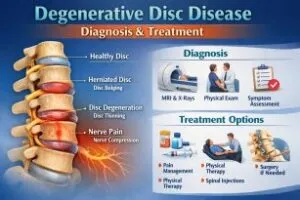 Degenerative disc disease (DDD) is one of the most common causes of back and neck pain in adults. While the name sounds alarming, it’s not actually a “disease” in the traditional sense—it’s a natural part of aging where the spinal discs lose hydration, elasticity, and height over time. These changes can lead to pain, stiffness, and sometimes nerve irritation. At Southwest Scoliosis and Spine Institute, we see many patients who are surprised to learn they possess the early signs of DDD, often wondering how it was diagnosed and what their options are moving forward.
In this blog, we’ll walk you through how degenerative disc disease diagnosis and treatment options are formulated for each individual patient —from conservative approaches to advanced surgical solutions. Our goal is to help you understand your condition and feel empowered when discussing it with your doctor.
How do Doctors diagnose Degenerative Disc Disease?
Diagnosis starts with a thorough evaluation because DDD symptoms (like chronic back pain, radiating leg or arm pain, stiffness, or weakness) can overlap with other spine issues.
- Medical History and Physical Exam: Your doctor will ask about your symptoms: When did the pain start? Is it worse with certain activities (bending, lifting, sitting)? Do you experience numbness or tingling? A physical exam checks your range of motion, strength, reflexes, and areas of tenderness.
- Imaging Tests:
- X-rays: These show disc height loss, bone spurs, or alignment issues—often the first clue of degeneration.
- MRI (Magnetic Resonance Imaging): The gold standard for DDD. It reveals disc dehydration (dark discs on T2 images), bulging, herniation, or nerve compression.
- CT Scan: Sometimes used for detailed bone views if MRI isn’t possible.
- Discography (rarely): Injecting dye into discs to provoke pain and confirm the source. Doctors use this procedure when considering surgery.
- Other Tests: Nerve studies (EMG) or blood tests may rule out conditions like infections or inflammatory arthritis.
Early diagnosis is key—many people who have no back pain experience disc changes as they age, and find them during an MRI. So we correlate imaging with your symptoms to avoid unnecessary treatment.
Treatment Options: From Conservative to Surgical
There’s no cure for DDD, but excellent options exist to manage pain and maintain function. Treatment is always personalized, starting conservatively and escalating only if needed. If you would like more details on specific solutions, you can see our comprehensive page on Degenerative Disc Disease.
Non-Surgical (Conservative) Treatments
Most patients (80–90%) improve without surgery:
- Physical Therapy: Core strengthening, flexibility exercises, and posture training reduce stress on discs.
- Medications: Anti-inflammatories (NSAIDs), muscle relaxants, or short-term pain relievers.
- Lifestyle Changes: Weight management, ergonomic adjustments, low-impact exercise (swimming, walking), and quitting smoking (smoking accelerates degeneration).
- Injections: Epidural steroids or facet joint injections for targeted pain relief and reduced inflammation.
Regenerative and Minimally Invasive Options
Emerging therapies we’re excited about:
- Platelet-Rich Plasma (PRP): Using your blood’s growth factors to promote healing.
- Stem Cell Therapy: Investigational but promising for disc regeneration in select cases.
Surgical Treatments
When conservative measures fail, and pain severely impacts life, doctors will recommend surgery:
- Microdiscectomy: Removes herniated disc material pressing on nerves—minimally invasive with quick recovery.
- Spinal Fusion: Joins vertebrae for stability, often with bone graft and hardware.
- Artificial Disc Replacement: Preserves motion by replacing the damaged disc with an artificial one—ideal for younger, active patients.
Success rates are high in properly selected patients, with many returning to normal activities.
When to See a Specialist
If pain lasts more than a few weeks, worsens with activity, or includes leg/arm weakness, bowel/bladder changes, or numbness, seek evaluation promptly. Early intervention often prevents progression.
At Southwest Scoliosis and Spine Institute, our board-certified spine specialists—led by Richard Hostin, MD, Devesh Ramnath, MD, Ishaq Syed, MD, Shyam Kishan, MD, and Kathryn Wiesman, MD– specialize in all types of spine conditions, deformities, and back pain and have decades of experience diagnosing and treating DDD with the latest evidence-based approaches.
We also address related concerns, such as whether DDD qualifies as a disability (read our blog: Is Degenerative Disc Disease Considered a Disability?).
Significantly, these surgeons have treated over 100,000 patients and performed more than 16,000 successful scoliosis surgeries, including complex and revision cases. If you are seeking medical treatment from the Spine Experts at the Southwest Scoliosis and Spine Institute, we have offices in Dallas, Plano, and Frisco, Texas.
Appointments are available within 24 hours. Contact us today: (214) 556-0555 or request an appointment online.
____________________
Citation: National Institute of Health – Lumbar Degenerative Disc Disease
The medical content on this page has been carefully reviewed and approved for accuracy by the Medical City Children’s Orthopedics and Spine Specialists’ qualified healthcare professionals, including our board-certified physicians and Physician Assistants. Our team ensures that all information reflects the latest evidence-based practices and meets rigorous standards of medical accuracy, with oversight from our expert spine doctors to guarantee reliability for our patients.
If you or your loved one is suffering from back pain from a spinal condition, there is hope. We can help. Call Southwest Scoliosis and Spine Institute at 214-556-0555 to make an appointment today.
Recent Comments